The ADA Interactive Process: What HR Can Ask For (and What It Can't)
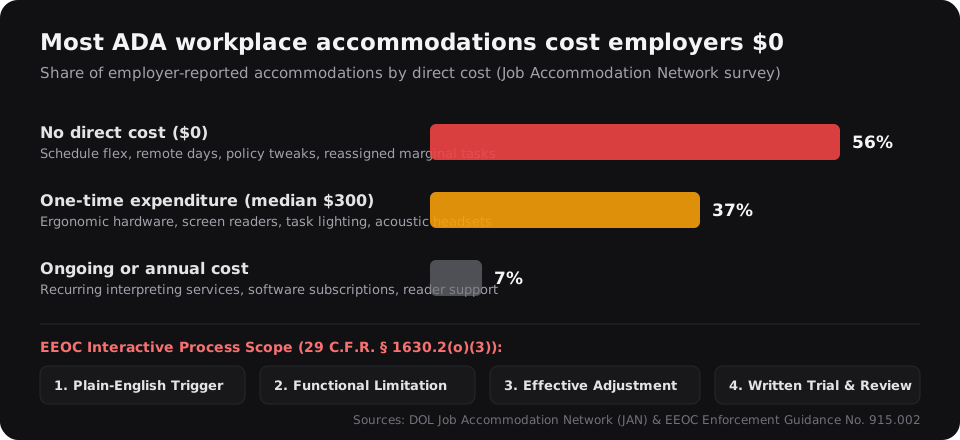
Most workplace accommodation requests don't stall because the adjustment is expensive. In the Department of Labor's Job Accommodation Network (JAN) ongoing employer study, 56% of workplace accommodations cost $0, and the 37% that involve a one-time purchase carry a median cost of $300. Requests stall when the paperwork turns into a standoff: the employee sends a vague note ("Needs remote work for medical reasons"), and HR sends back a sweeping release demanding three years of raw chart notes.
Under Title I of the Americans with Disabilities Act (42 U.S.C. § 12112(b)(5)(A)) and the Equal Employment Opportunity Commission's Enforcement Guidance on Reasonable Accommodation and Undue Hardship (No. 915.002), neither of those moves matches how the law is written. Below: what actually starts the ADA interactive process, the exact line between permissible medical questions and overreach, why linking functional limitations to essential job duties wins approvals, an illustrative weak vs. audit-ready request, and a 60-second check before you hit send.
Note: This article provides general educational information grounded in public federal regulations and EEOC guidance, not legal advice. Title I of the federal ADA covers employers with 15 or more employees; state and local laws often cover smaller employers.
No magic words start the clock, but written clarity keeps it moving
In Question 1 of its Enforcement Guidance, the EEOC states the trigger rule directly: when an individual decides to request an accommodation, they must let the employer know that they need an adjustment or change at work for a reason related to a medical condition. To do that, the employee "may use 'plain English' and need not mention the ADA or use the phrase 'reasonable accommodation.'"
The guidance gives concrete pairs that show where the line sits:
- Triggers the process: Telling a supervisor, "I'm having trouble getting to work at my scheduled starting time because of medical treatments I'm undergoing." That connects a work rule (start time) to a medical reason.
- Does not trigger the process: Telling a supervisor you're tired and would like a new chair, without tying the request to a medical condition.
Once a request is made, federal regulations at 29 C.F.R. § 1630.2(o)(3) describe the next step: it may be necessary for the covered entity "to initiate an informal, interactive process with the individual with a disability in need of the accommodation." That process has a specific job: "identify the precise limitations resulting from the disability and potential reasonable accommodations that could overcome those limitations."
Notice the sequence in the regulation. It doesn't start with a fight over your diagnosis code. It starts with functional limitations and workplace barriers.
What HR can ask for vs. what crosses the line
Employers are allowed to verify a non-obvious need, and employees are protected from fishing expeditions. Questions 6 through 8 of the EEOC's Reasonable Accommodation Guidance and its companion Enforcement Guidance on Disability-Related Inquiries and Medical Examinations of Employees draw four bright rules:
| Situation | What HR may request (EEOC Guidance) | What HR may not require |
|---|---|---|
| Disability and need for accommodation are not obvious (Q6) | Reasonable documentation that (1) establishes an ADA disability and (2) explains why the disability necessitates a workplace accommodation (functional limitations). | Unrelated medical records or a blanket release for your entire medical chart ("because the record will contain information about conditions that have no bearing on the accommodation"). |
| Disability and need are obvious or already on file (Q8) | No additional medical documentation about the disability. | Repeated doctor's notes proving a known, permanent condition that has already been substantiated. |
| Clinician's note is insufficient or vague (Q7) | After explaining why the note is insufficient and giving the employee a chance to provide the missing detail, HR may ask for supplemental targeted facts or (with consent) contact the provider. | Sending the employee to the employer's own doctor first without explaining what was missing from the treating clinician's note. |
| Genetic / family medical history (29 C.F.R. § 1635.8(b)(1)(i)) | Must include GINA safe-harbor warning language telling the provider not to disclose genetic or family medical history. | Requesting family medical history, genetic test results, or genetic predisposition data under Title II of GINA. |
Two confidentiality rules in the ADA back this up. First, under 29 C.F.R. § 1630.14(c)(1), any medical information obtained during the accommodation process must be "collected and maintained on separate forms and in separate medical files and be treated as a confidential medical record"—never dropped into a general personnel folder where anyone can browse it. Second, supervisors and managers may be told about necessary restrictions on the work or duties of the employee and necessary accommodations, not the underlying medical file.
Why "essential functions" vs. "marginal functions" decides the request
A reasonable accommodation exists to enable a qualified employee to perform the essential functions of the position (29 C.F.R. § 1630.2(n)). Under the EEOC guidance:
- An employer never has to eliminate an essential function (a fundamental duty the job exists to perform), nor lower quantitative or qualitative production standards that are applied uniformly.
- An employer can be required to reallocate or redistribute marginal functions (minor or incidental tasks that aren't the reason the position exists) and to modify how, when, or with what equipment an essential function is performed.
That distinction explains why so many well-meaning doctors' notes backfire. When a physician writes, "Patient cannot perform stressful tasks or meet tight deadlines," HR reads that as "Patient cannot perform essential functions." When the physician instead writes, "Condition limits sustained fluorescent-lit screen exposure and auditory processing in open-plan rooms; employee can perform all analytical and reporting duties with dark-mode display software, written task summaries, and a quiet workstation or two remote days per week," the note proves the employee can perform the essential functions once the environmental barrier is addressed.
Your preferred option vs. an "effective" alternative
One point catches employees off guard during the interactive meeting: you are entitled to an effective accommodation, not necessarily the specific one you asked for first. In Question 9 of the EEOC Guidance and the Appendix to 29 C.F.R. § 1630.9, the employer has the ultimate discretion to choose between two effective accommodations, including choosing the one that is less expensive or easier to provide.
The keyword is effective. An alternative that leaves the functional barrier intact isn't an effective accommodation. That's why offering two concrete options in your initial request—and proposing a 30-to-60-day trial period with a scheduled check-in—puts you in the strongest position during the interactive process. If HR counters with an alternative that won't work, you can point back to the specific functional limitation and explain why the counter-proposal doesn't clear the barrier, or agree to test it for 30 days with an objective review date.
One accommodation request, rewritten
Here is a weak request email and an ADA-aligned version for the same role (a financial analyst recovering from post-concussion vestibular migraines). Both are illustrative examples written for this post, not a real employee or case.
Weak:
Hi HR, I've been dealing with severe migraines and photophobia since my accident last month. My doctor says the office is making my symptoms worse and I need to work from home full-time starting Monday. Let me know when this is approved.
This request leaves out what essential duties the employee performs, treats only one option as acceptable, gives no duration or review date, and invites a flat "in-office presence is essential" rejection.
ADA-aligned:
Subject: Request for Workplace Accommodation — Senior Financial Analyst
Hello [HR Partner Name],
I am writing to request a workplace adjustment related to a medical condition so I can continue performing all core financial modeling, audit reconciliation, and stakeholder reporting duties at full capacity.
Functional limitation & workplace barrier: My treating neurologist is managing a post-concussion neurological condition that causes severe symptoms under overhead fluorescent lighting and sustained multi-speaker background noise on the 4th-floor open floorplan. The condition does not limit my analytical output, spreadsheet modeling, or video/written communication when lighting and acoustics are controlled.
Proposed effective accommodations (for a 90-day recovery window):
1. Option A (Primary): A temporary hybrid schedule working remotely Monday, Wednesday, and Friday, with Tuesday/Thursday on-site in a natural-light quiet focus room during core team collaboration hours.
2. Option B (Alternative on-site adjustment): Relocation to a perimeter workstation with overhead fluorescent tubes disabled/filtered, a glare screen filter, and permission to use noise-canceling headphones with written agendas for 1:1 check-ins.
My neurologist can provide targeted documentation of the functional limitation and expected 90-day duration if helpful. Please let me know a good time this week to discuss this in the interactive process.
Sincerely,
[Employee Name]
Every sentence does a specific job: it triggers the interactive process in plain English, separates the medical limitation from the essential job functions, offers two practical options (both costing $0), states a clear review window, and invites the interactive conversation.
A 60-second check before you send your request
- Tie the request to a medical condition in plain English. You don't need statutory citations, and you don't need to overshare your entire medical history—just make clear the adjustment is for a medical condition.
- Describe the functional limitation and the workplace barrier. Explain what in the environment or schedule creates the barrier (lighting, lifting, standing duration, morning medication window, acoustic noise).
- Affirm your essential job functions. State clearly that the adjustment enables you to perform the core duties of your role.
- Offer two workable options when possible. Give a primary proposal and a practical fallback so the interactive conversation starts with solutions, not an ultimatum.
- Keep your doctor's note scoped to function and duration. Ask your clinician to state the functional limitation, the job barrier, why the accommodation addresses it, and the expected duration—not raw progress notes.
- Log every conversation and follow up in writing. After a phone or hallway chat with HR or your manager, send a polite 4-line recap email the same day confirming what was discussed and the next step.
If your condition requires time off for treatment or flare-ups alongside on-the-job adjustments, read our guide on how to write an FMLA request letter and compare how intermittent leave works with our Free AI FMLA Request Letter Tool. For step-by-step templates covering every stage of the accommodation process, see our complete guide to requesting an ADA workplace accommodation, and use the Paper Trail Timeline to keep your dated correspondence organized.
FAQ
Do I have to say "Americans with Disabilities Act" or "reasonable accommodation" to start the process?
No. Under EEOC Enforcement Guidance on Reasonable Accommodation (Question 1), an employee may use "plain English" and does not need to mention the ADA or the phrase "reasonable accommodation." Linking a work adjustment to a medical condition is enough to trigger the interactive process.
Can HR require my complete medical records to approve a workplace accommodation?
No. Under EEOC Enforcement Guidance (Question 6), when a disability or need for accommodation is not obvious, an employer may request reasonable documentation limited to the specific condition and functional limitation at issue. The EEOC states an employer "cannot ask for unrelated documentation" or a complete medical history because a record will contain information unconnected to the workplace need.
Does my employer have to grant the exact accommodation I ask for?
Not if another effective option exists. Under the Appendix to 29 C.F.R. § 1630.9 and EEOC Question 9, the employer may choose among effective accommodations, including a lower-cost or easier-to-provide alternative, as long as the chosen adjustment genuinely removes the workplace barrier.
Put your request in writing before the meeting
The interactive process works best when you arrive with a clear functional map instead of a blank page. Open the free CyberScryb AI Workplace Accommodation Companion to map your job barriers to proposed adjustments, draft your initial request letter, build a scoped checklist for your healthcare provider, or write a calm post-meeting follow-up recap. It's free, requires no account, and keeps your interactive process tracker right in your browser.