SOAP Note Documentation: What Auditors Actually Flag
Medicare made an estimated $28.83 billion in improper payments in its 2025 report. More than half of that money, 53%, landed in one bucket: insufficient documentation. Not fraud. Not the wrong treatment. Records that didn't prove what was billed.
That's the real job of SOAP note documentation. When a reviewer or a lawyer opens your chart, the note is the only witness, and it can't take questions. Below: what reviewers flag most, the right way to fix a note after the fact, why cloned and AI-drafted notes are a trap, one weak note rewritten line by line, and a 60-second check to run before you sign.
Your note gets read by people who weren't there
You write a SOAP note for the next nurse, the doctor, or the therapist on Thursday. That's the audience you picture. But the American Nurses Association's Principles for Nursing Documentation names the other readers too: payors, government agencies, accrediting bodies, and the legal system. It says patient records "are important evidence in legal matters," and that documentation that is incomplete, untimely, or false can put providers "at risk of liability."
Those readers share one trait. They weren't in the room. They can't ask what "tolerated well" meant, or whether "VSS" covered a blood pressure of 168/94. They grade the page, not you.
The numbers in this post come from Medicare's audit program, because Medicare publishes its error data in detail. Private insurers and malpractice attorneys aren't bound by Medicare's manuals, but they read the same chart.
What "insufficient documentation" means to a reviewer
CMS measures payment errors through the Comprehensive Error Rate Testing (CERT) program, which pulls a random sample of claims each year and requests the records behind them. Its documentation fact sheet (MLN909160) defines the error plainly: the reviewer "couldn’t determine whether some of the allowed services were actually provided, were provided at the level billed, or were medically necessary."
That gives you three questions every note has to answer without help:
- Did it happen? What exactly was done, by whom, on what date.
- At the level billed? Enough detail to support the time, intensity, or service code.
- Was it necessary? Findings that explain why this patient needed this care today.
The same fact sheet adds a second trigger. A claim also fails when a required element is missing, "like a physician signature on an order, or a form that’s not entirely completed." Good care with a blank signature line still counts as an error.
The flags at the top of CMS's 2025 list
The 2025 supplemental data breaks errors down by "root cause." It covers claims submitted from July 2023 through June 2024. Here's the overall split of improper payment dollars:
| Error category | Share of improper payments |
|---|---|
| Insufficient documentation | 53.0% |
| Medical necessity | 15.3% |
| No documentation | 12.0% |
| Incorrect coding | 11.1% |
| Other | 8.5% |
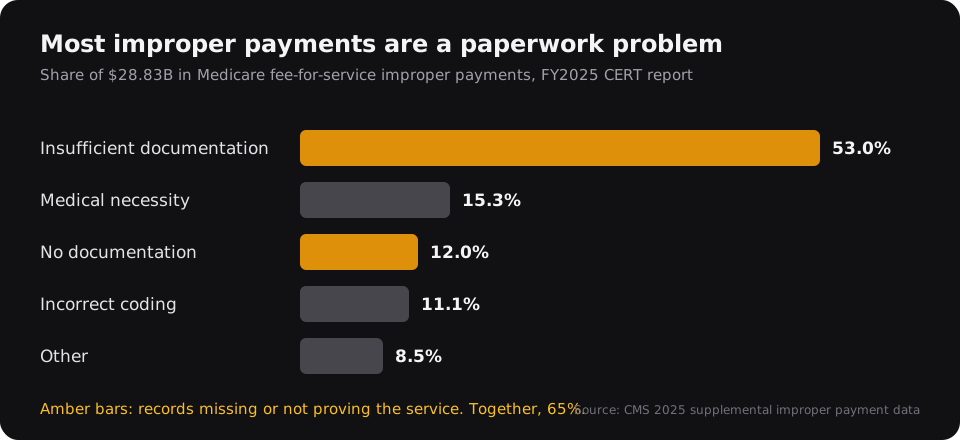
Add "no documentation" (the provider never sent records) and 65% of the problem is paperwork that was missing or didn't prove the case.
The root-cause tables get more specific, and they read like a list of SOAP note habits:
- Skilled nursing facilities had $4.3 billion in improper payments, an 11.8% error rate. The top root cause, in 327 sampled claims, was "HIPPS level changed based on documentation submitted." HIPPS is the code that sets a facility's payment level. In other words, the chart didn't support the payment category the facility billed. Missing orders showed up in 160 claims. Documentation for "PT/OT and/or Nursing Functional Scores" was cited as missing in 98 claims and inadequate in 94 more.
- Hospital outpatient services led with "documentation to support medical necessity - Missing" and "documentation for the billed date of service - Missing."
- Therapy paperwork led the list for Part B minor procedures: a missing physician certification of the plan (62 claims), a missing reason for a late certification (28), and and a missing progress report "performed at least once every 10 treatment days" (12).
Notice what's absent. These aren't findings that the nurse picked the wrong wound dressing. They're findings that nobody could prove what was done, or why.
For a SOAP note, the lesson is mechanical. Your Assessment and Plan are claims. Your Subjective and Objective sections are the evidence for them. If the A says "improving," the O needs the number that improved.
Cloned notes: copy-forward reads as fiction
Electronic records made one bad habit nearly effortless: carrying yesterday's note into today. A systematic review in Applied Clinical Informatics found that 66% to 90% of clinicians routinely copy and paste. CMS has a name for the result: cloning.
A CMS decision table on EHR features says cloned documentation "lacks the patient-specific information" needed to support the service, and lists "false impression of services provided" among the ways it leads to improper payments. Its recommendation is worth taping to your monitor: recognize "each encounter as a stand-alone record."
The risk isn't only financial. The Joint Commission's Quick Safety bulletin on copy and paste describes a patient discharged from the emergency department with new atrial fibrillation and told to follow up with his primary care doctor for a stress test. The doctor copied the same Assessment and Plan into 12 office visits over the next two years. The patient died of a heart attack, and the doctor was found liable.
Here's the uncomfortable part about auditing. In a 2014 report, the HHS Office of Inspector General noted that copied language is hard to spot in a single claim, because it "may require a single reviewer to examine multiple claims from a single patient or provider." So the reviewers who catch cloning are the ones looking at a stack of your notes side by side. That's exactly when identical wording looks worst.
Copying isn't banned. The safe version, per the Joint Commission and CMS guidance: never copy across patients or into signature lines, never paste text you haven't read and edited, and change anything that isn't true today.
Late entries and corrections: the right way vs. the way that looks like tampering
You will forget something. Medicare's Program Integrity Manual, chapter 3, expects services to be documented "at the time they are rendered," but section 3.3.2.5 allows amendments, corrections, and delayed entries as long as "the date and author of any amendment, correction or delayed entry" are identifiable and the change is "clearly and permanently denoted."
Noridian, one of the contractors that processes Medicare claims, spells out the mechanics in its guidance on amended records:
- Late entry: adds something you left out. It carries today's date, goes in as soon as possible, is written only if you have "total recall of the omitted information," and you sign it.
- Addendum: adds information that wasn't available yet, like a lab result. Today's date, the reason, your signature.
- Correction: never write over or obliterate the original. On paper, draw a single line through the error so it stays legible, initial and date it, give the reason, and write the correct information with the current date. Electronic records follow the same principle: keep the original, and track the change with date, time, reason, and who made it.
Two things turn an honest fix into a red flag. The first is backdating. The manual says even a valid signature attestation "cannot be used to 'backdate'" a document that had to be signed by a certain date. The second is thinking an edit is invisible. Electronic records can log who changed what and when, and the OIG has recommended that Medicare's contractors use providers' audit logs when reviewing records. A clearly labeled late entry looks like a careful clinician. A silent rewrite of a three-day-old note, sitting in the log, looks like something else.
Signatures: the boring flag that still denies claims
Signatures sound like a formality until you read the manual. Section 3.3.2.4 of the Program Integrity Manual covers the rules reviewers apply:
- Stamped signatures are "not typically acceptable." The one exception is an author with a documented disability that prevents signing.
- Illegible signatures can be rescued with a signature log, a list matching printed names to initials or scrawls.
- Missing signatures can sometimes be fixed with an attestation statement, but only from the person who wrote the entry. The manual is blunt: even within the same group, "one should not sign for the other."
- Undated notes can survive if the rest of the record makes the date clear. Don't make a reviewer reconstruct it.
When a review contractor offers you the chance to send an attestation or signature log, the manual gives you 20 calendar days (CERT runs on its own timeline). That's 20 days of chasing a former coworker for a signature you could have added in two seconds.
Your AI scribe doesn't sign for you
This one is new, and it matters for anyone drafting notes with software. The current Program Integrity Manual (the signature section was revised effective January 2025) says a scribe doesn't need to sign the note, because the treating practitioner's signature "affirms the note adequately documents the care provided." Then it adds: this concurrence "is also required when using Artificial Intelligence (AI) technology to capture the transcription of medical record entries."
Plain version: if an AI tool drafts it and you sign it, you own every word, including the ones you didn't read.
AI drafts also tend to run long, and length doesn't buy you anything. Medicare's Claims Processing Manual says "the volume of documentation should not be the primary influence" on the level of service billed. CMS's EHR decision table warns that macros and default text can produce "overdocumentation" and upcoding. A page of generic text about a diagnosis proves nothing about this patient on this date.
Use tools to format and speed you up. Supply the facts yourself, and read the whole thing before you sign.
One note, rewritten
Here's a weak note and an audit-ready version of the same home health visit. Both are illustrative examples I wrote for this post, not a real patient or real chart.
Weak:
S: Pt doing well. No complaints.
O: VSS. Wound healing.
A: Stable.
P: Continue POC.
Every line fails one of the three questions. "Doing well" isn't a finding. "VSS" (vital signs stable) hides the actual numbers. "Healing" has no measurement. "Continue POC" doesn't say what was done today or what happens next. A reviewer can't tell whether this visit needed a nurse at all.
Audit-ready:
S: Pt reports R heel pain 3/10 at rest, 6/10 during dressing change (5/10 at rest on 10/26). States, "It doesn't burn like before." Slept about 6 hours.
O: BP 132/78, HR 82, T 98.4°F, SpO2 96% on room air. R heel wound 2.1 × 1.8 × 0.3 cm (10/26: 2.6 × 2.0 × 0.4 cm). Red granulation tissue, scant clear drainage, no odor, surrounding skin intact. Dressing changed per order dated 10/20.
A: Wound smaller on all three measurements since last visit. Pain trending down. No signs of infection.
P: Continue dressing changes per order. Reviewed heel offloading boot; pt placed it correctly without help. Next visit 10/31. Will notify MD for increased drainage, odor, or temp of 100.4°F or higher.
Jane Doe, RN, 10/29/2026, 14:20
It isn't much longer. The difference is that every claim in A and P has a number or an observation behind it in S and O, the service is described, and the note is signed, credentialed, dated, and timed.
A 60-second check before you sign
Run this on every note. It takes about a minute once it's a habit.
- Read A and P, then hunt for their proof. Every "improved," "stable," or "declined" needs a value or observation in S or O.
- Swap vague words for measurements. Replace "VSS," "tolerated well," and "no change" with the actual numbers.
- Name today's service. What did you do, and is it covered by a current order or plan of care?
- Check what you carried forward. Anything copied from the last note has to still be true today. If it isn't, change it.
- Label any late entry or addendum with today's date and the reason. Never edit an old note silently.
- Sign with name, credentials, date, and time. No stamps, no colleague signing for you.
If you care for a family member at home and keep notes for their doctors, the same idea scales down. Our guide on documenting cognitive decline for doctors and courts and the post on what goes in a caregiver shift report apply the dated, specific approach to home care. And if you're on the patient side of a bad bill, how to dispute medical bill coding errors shows how the same records get used in your favor.
FAQ
Is a SOAP note a legal document?
Yes, in practice. It's part of the medical record, and the ANA calls patient records "important evidence in legal matters." Medicare reviewers also treat it as the proof behind a claim.
Can I fix a SOAP note after I sign it?
Yes, if you do it openly. Add a dated late entry, addendum, or correction with your name and the reason, and leave the original readable. Never backdate or overwrite.
Can AI write my SOAP note?
It can draft one. Medicare's Program Integrity Manual says the treating practitioner's signature is still required to affirm notes captured with AI, so you're responsible for every line you sign.
Write the note you'd want read aloud
Most audit losses aren't about bad care. They're about care nobody can prove. The fix is small: specific numbers, a clean late entry when you need one, and a real signature.
Your next step: open the free CyberScryb SOAP Note Generator, write your next note in its four sections, and run the 60-second check before you sign. It runs in your browser, stores nothing, and lays out the header and signature lines for you. The facts are still yours to supply.